

You have probably stood in front of the mirror, counted the hairs on your comb, and wondered if any of this actually works.
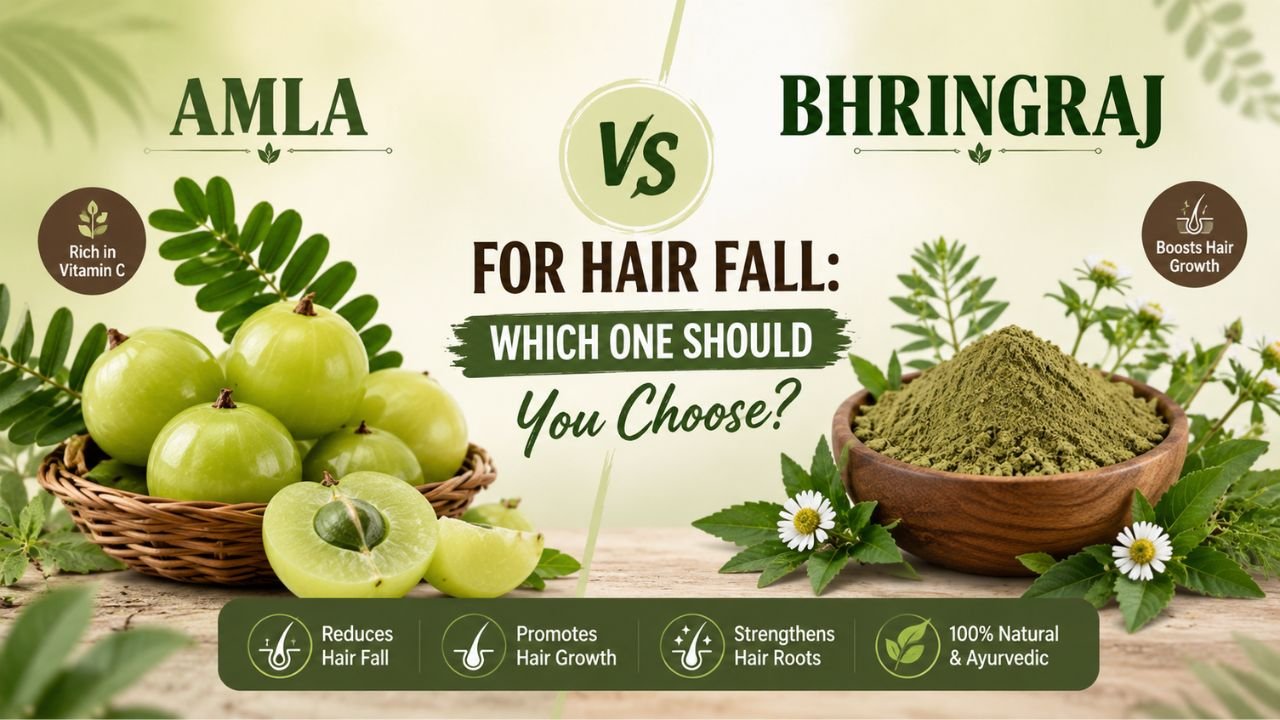
The powders, the oils, the grandmother’s remedy that promises thick hair in 30 days. And somewhere in the middle of all that, two names keep appearing: amla and bhringraj.
Both are ancient. Both are genuinely researched.
But they are not the same herb, they do not work the same way, and for your specific type of hair loss, one is likely to serve you better than the other. Most articles will not tell you that. This one will.
Key Takeaways
Amla (Phyllanthus emblica) currently holds the strongest human clinical trial evidence for androgenic hair loss, including a 2024 triple-blind RCT.
Bhringraj (Eclipta alba) shows powerful results in animal models and in vitro studies, working primarily through the Wnt/beta-catenin pathway to stimulate dormant follicles.
The two herbs work through different biochemical mechanisms, which means they complement each other rather than compete.
Neither herb can reverse advanced baldness, permanently darken grey hair, or replace medical treatment in severe androgenetic alopecia.
Combining both in a consistent routine gives you the most evidence-supported approach among Ayurvedic options.
The Scale of the Problem You Are Dealing With
Hair loss is not vanity. It affects confidence, identity, and daily wellbeing in ways that are entirely legitimate.
Androgenetic alopecia affects 30 to 50 percent of men by age 50, making it the most common form of hair loss in men.
Among both sexes, roughly 50 percent of males and up to 19 percent of females will experience it at some point.
The cause is largely genetic, driven by an excessive androgen response at the follicle level. But not all hair fall is androgenic.
Telogen effluvium, triggered by stress, illness, postpartum changes, or nutritional deficiency, is a completely different mechanism, and the herb you choose should reflect that distinction.
This is where most guides skip a critical step.
How Amla Works: The Biochemistry Behind the Berry
Amla, the dried fruit of Phyllanthus emblica, is one of the most antioxidant-rich botanicals on the planet.
Its mechanism of action in hair loss is now fairly well understood.
The primary pathway is 5-alpha reductase inhibition. DHT (dihydrotestosterone) is the androgen primarily responsible for follicle miniaturisation in androgenetic alopecia.
Amla’s polyphenols, particularly ellagic acid and gallic acid, appear to interfere with the enzyme that converts testosterone to DHT.
This is the same enzyme that prescription finasteride targets. Amla also delivers collagen-supporting vitamin C to the scalp, reduces oxidative stress on follicle tissue, and may prolong the anagen (active growth) phase.
The clinical evidence for amla is, frankly, the strongest in the Ayurvedic hair category right now.
A 2024 triple-blind randomised controlled trial published in the Journal of Ethnopharmacology followed 60 women with female androgenetic alopecia over 12 weeks.
Those taking oral amla syrup showed a significantly increased anagen-to-telogen ratio compared to placebo (F=10.4, P=0.002), with both physician and patient satisfaction significantly higher (P less than 0.001) in the amla group. That is meaningful data, not anecdote.
A separate 90-day clinical study published in PMC tracked 42 subjects using a hair serum containing amla extract.
TrichoScan measurements showed statistically significant improvement in hair growth rate, hair density, vellus hair density, and terminal hair density, all at p less than 0.0001 versus baseline.
These are real, measurable outcomes.
If your hair loss has a hormonal or androgenic root, amla has the best human evidence among Ayurvedic herbs available today.
You can explore amla-based powder formulations here and read more about how traditional powders are used in hair care.
How Bhringraj Works: A Different Pathway, A Different Strength
Bhringraj, or Eclipta alba, earns its Sanskrit title “King of Herbs” for hair for a reason. But its mechanism is distinct from amla’s.
The primary active compounds, including wedelolactone and ecliptine, appear to work through the Wnt/beta-catenin signalling pathway, which is a key regulator of hair follicle cycling.
Bhringraj may also upregulate VEGF (vascular endothelial growth factor), improving blood circulation to the scalp, promote dermal papilla cell proliferation, and reduce oxidative stress in scalp tissue.
A 2025 review published in the International Journal of Sciences and Innovation Engineering confirmed that bhringraj inhibits 5-alpha reductase activity and improves collagen synthesis, making it relevant for androgenic hair loss as well.
The animal-model data is compelling. A study published in Archives of Dermatological Research found that bhringraj extract reduced hair growth initiation time to roughly half that of control animals, with complete hair growth also significantly accelerated.
A 2021 review in the Asian Journal of Pharmaceutical and Clinical Research confirmed its traditional use for hair fall, dandruff, premature greying, and scalp inflammation.
Here is the honest caveat: bhringraj’s most impressive results are still primarily from animal studies and in vitro research.
The human clinical trial data, while promising, is thinner than amla’s.
A lab study cited by Healthline found that Eclipta alba extract may function similarly to certain 5-alpha reductase inhibitors including finasteride, but researchers noted the study did not examine whether this translates directly to human hair loss treatment.
Where bhringraj genuinely shines is in scalp health, stress-related hair fall, and early-stage thinning, where improving circulation and stimulating dormant follicles matters most.
For a practical starting point, see this related guide to bhringraj powder for hair growth and the deeper overview of bhringraj benefits.
You can also find pure bhringraj powder formulations here.
Matching the Herb to Your Hair Loss Type
This is the part most guides skip entirely.
Choose amla as your primary herb if: your hair loss is androgenic (pattern thinning at crown or temples), you have a family history of hair loss, or you are a woman experiencing post-menopausal or hormonal hair thinning.
Amla’s 5-alpha reductase pathway and its proven human RCT data make it the more evidence-supported choice for DHT-driven loss.
Choose bhringraj as your primary herb if: your hair fall is recent and stress-triggered (classic telogen effluvium), you have a dry or inflamed scalp, your hair is breaking rather than falling from the root, or you want to focus on stimulating circulation and follicle activation.
Bhringraj’s Wnt/beta-catenin and VEGF mechanisms are directly relevant here.
Use both together if you want the most comprehensive Ayurvedic approach.
Dr. Sanjay Kumar Acharya’s 2025 review states explicitly that when bhringraj is combined with amla and other herbs, its therapeutic value is “further enhanced,” with the combination addressing hormonal balance, oxidative stress, and circulation simultaneously.
This is essentially the formula behind classical Bringadi taila, the traditional Ayurvedic hair oil. A well-formulated ubtan face pack follows this same logic of synergistic herbs.
For topical support, a quality rosemary oil and a pure aloe vera gel make strong companions to either herb in a scalp routine.
What Neither Herb Can Do: Setting Honest Expectations
Two misconceptions need to be addressed directly, because believing them will lead to frustration.
Greying hair. Dr. Ekansh Shekhar, dermatologist and trichologist, has stated clearly that the claim that amla or bhringraj can turn grey hair black “is not scientifically realistic.”
Hair colour is produced by melanin from pigment-making cells inside the follicle.
When those cells slow down or stop, the hair grows out grey.
No herbal preparation can restart melanin production from outside the follicle with current evidence.
Advanced baldness. Bhringraj and amla work by stimulating dormant follicles and reducing follicle miniaturisation.
On a scalp with no remaining active follicles, the effectiveness is minimal. Both herbs are best understood as preventive and early-intervention tools.
For clinically significant hair loss, the Mayo Clinic’s guidance on hair loss diagnosis and treatment remains the appropriate starting point, with options like minoxidil and finasteride having substantially stronger evidence for advanced cases.
Realistic timelines matter too. Most clinical studies showing results ran for 12 to 16 weeks of consistent use.
Expect a minimum of three to four months before evaluating whether your chosen herb is working.
A 2025 narrative review from the University of Miami Miller School of Medicine, published in PMC, reviewed 16 studies on Ayurvedic treatments for hair disorders and concluded that the evidence is promising but that most studies remain small and short.
The honest position is that these herbs are useful, evidence-informed adjuncts, not standalone cures.
A Note on Safety
Ayurvedic herbs are not automatically safe for everyone. Some traditional preparations carry a risk of heavy metal contamination due to rasa shastra processing methods.
Certain herbs may increase bleeding risk or interact with medications.
Both amla and bhringraj should be avoided during pregnancy and breastfeeding unless a qualified clinician has specifically advised otherwise.
Source your supplements from verified, tested brands and discuss any significant hair loss with a dermatologist before starting any herbal protocol.
Conclusion
Amla and bhringraj are not competitors. They are colleagues, addressing different parts of the same problem through different biochemical routes.
If your hair loss is hormonally driven, amla is your best-evidenced Ayurvedic option right now, backed by the most rigorous human trial data in this category.
If your hair is falling due to stress, poor scalp circulation, or early thinning, bhringraj gives you targeted follicle-stimulating support that amla alone does not provide.
Together, they form the most clinically coherent Ayurvedic hair protocol available.
What matters most is consistency, realistic expectations, and knowing when to involve a dermatologist.
These herbs work gradually, at the level of follicle biology, not overnight. Give them the three to four months they need, choose quality sourced products, and track your progress with photographs rather than feelings.
Your hair deserves that kind of patience.
Medical disclaimer: Medical Disclaimer: This article is intended for general informational purposes only and does not constitute medical advice, diagnosis, or treatment. The information provided reflects publicly available research and should not be used as a substitute for professional medical consultation.