
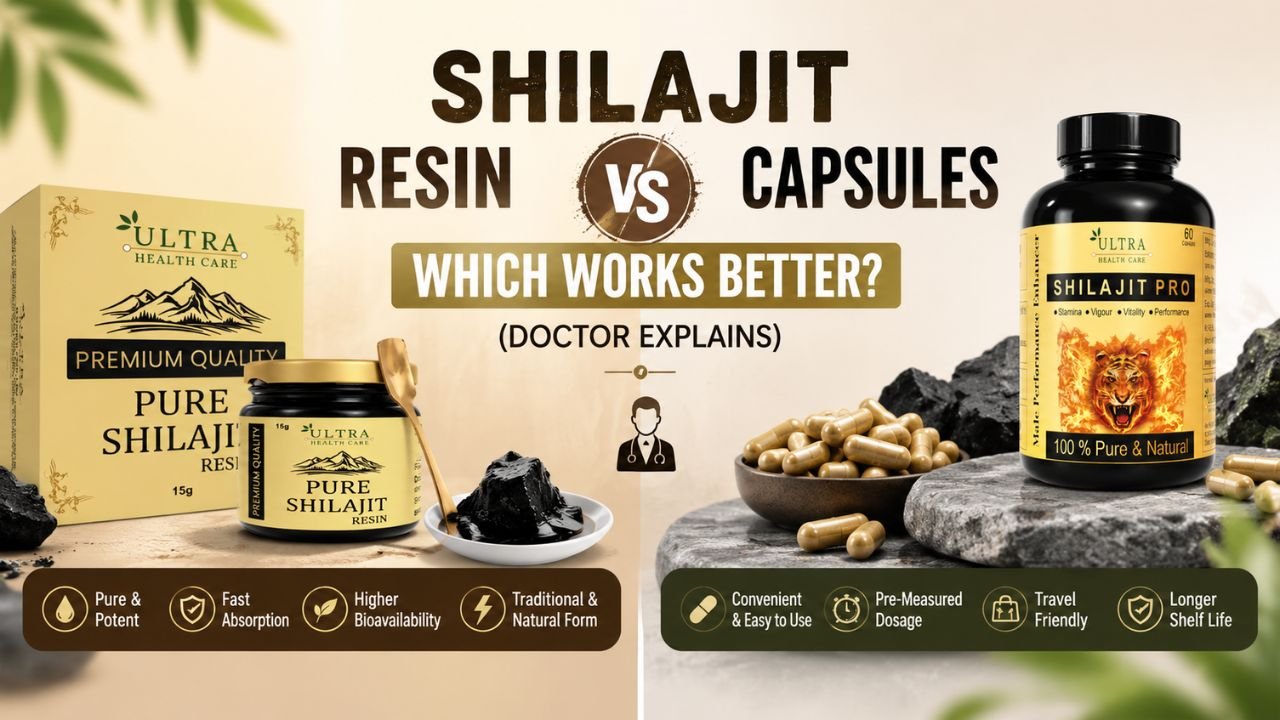
You have been staring at two products for ten minutes. One is a small amber jar of dark, sticky resin that smells faintly of earth and minerals.
The other is a clean blister pack of capsules with a lab-certified label and a QR code. Both claim to be “pure Himalayan shilajit.” Both claim superior bioavailability.
Both are priced like something precious.
So which one do you buy?
This question has gotten harder, not easier, as the shilajit market explodes. The global shilajit industry was valued at approximately $175.6 million in 2023 and is growing at roughly 9% annually.
That growth has flooded the market with products ranging from genuinely therapeutic to outright fraudulent.
Before you can choose between resin and capsules, you need to understand something more fundamental: what you are actually buying, and how to tell the difference between real shilajit and a label with good graphic design.
Key Takeaways
Shilajit resin typically preserves more of its natural bioactive structure and absorbs faster, but carries a higher risk of heavy metal contamination if not properly verified.
Capsule-form shilajit can be equally effective, but only if the manufacturer uses freeze-drying rather than spray-drying, which can destroy up to 30% of active compounds.
Fulvic acid percentage claims on labels are often a marketing decision, not a scientific one. Genuine purified resin contains 15–22% fulvic acid by mass when tested against validated methods.
The landmark clinical studies that proved shilajit’s testosterone and sperm health benefits used standardized capsule-form shilajit and still achieved significant results.
Format matters less than three things: standardized fulvic acid content, third-party heavy metal testing, and 90 days of consistent use.
What Shilajit Actually Is (And Why Form Matters)
Shilajit is not an herb. It is a sticky, resinous exudate that seeps from rock layers in the Himalayas, Altai, and Caucasus mountains over thousands of years, formed through the slow microbial decomposition of plant matter under intense pressure.
In Ayurvedic medicine, it has been classified as a rasayana, an adaptogenic substance believed to restore vitality and slow aging.
Its primary bioactive compounds are fulvic acid, dibenzo-alpha-pyrones (DBPs), and more than 85 trace minerals, according to a comprehensive review published in the International Journal of Alzheimer’s Disease.
Fulvic acid is the molecule that carries minerals into cells, facilitates ATP production, and, in emerging research, shows promise in blocking tau protein self-aggregation, a mechanism relevant to Alzheimer’s disease.
The review’s authors wrote directly: “Fulvic acid, the main active principle, blocks tau self-aggregation, opening an avenue toward the study of Alzheimer’s therapy.”
The form shilajit takes, resin, capsule, powder, or tablet, determines how much of this bioactive matrix actually reaches your bloodstream intact.
The Resin: What It Gets Right
Raw purified resin is the closest thing to shilajit in its natural state after processing to remove heavy metals and microbial contamination.
When you dissolve a pea-sized amount in warm water and drink it, absorption begins within minutes. There is no capsule shell to dissolve, no compression that might reduce surface area, no binding agents competing for absorption sites.
Industry data from Kashmiril’s research suggests resin contains 60–80% fulvic acid versus 20–50% in typical capsules, with some capsule products containing only 5–10% actual shilajit.
Those numbers come with an important caveat, which we will address shortly. But the directional claim, that resin preserves more of the natural compound matrix, is generally supported by process chemistry.
Heat damages organic molecules. Resin skips the manufacturing steps that introduce that heat.
If you are looking for a pure shilajit resin with verified sourcing, that is a reasonable place to start, provided you verify the Certificate of Analysis.
The Capsule: What the Marketing Misses
Here is what most comparison articles do not tell you. Not all capsules are made the same way, and the manufacturing method changes everything.
Most commercial shilajit capsules are made by spray-drying, a process that blasts the resin with hot air at 80 to 150 degrees Celsius to evaporate moisture and create a dry powder.
That heat exposure can degrade heat-sensitive compounds by up to 30%, according to data cited by Wellbeing Nutrition’s guide.
Dibenzo-alpha-pyrones are particularly vulnerable. You end up with a capsule that technically contains shilajit but has lost a meaningful portion of what made it worth taking.
Premium capsule manufacturers use freeze-drying instead.
Moisture is removed at freezing temperatures, preserving 90 to 95% of active compounds. The resulting powder is then encapsulated without fillers or binders that might reduce absorption.
Shilajit capsules made with purified, standardized extract using this process can deliver results comparable to well-sourced resin, which brings us to the clinical evidence.
What the Clinical Studies Actually Show
This is where the resin-versus-capsule debate becomes genuinely interesting, and where intellectual honesty requires saying something most vendor articles will not.
The strongest clinical evidence we have for shilajit’s benefits comes from studies that used capsule-form standardized extract, and the results were significant.
A randomized, double-blind, placebo-controlled trial published in Andrologia found that 90 days of purified shilajit supplementation significantly increased total testosterone, free testosterone, and DHEAS in healthy men between 45 and 55 years of age.
The increase in testosterone compared with placebo was statistically significant at P less than 0.05, with gonadotropic hormone levels well maintained.
A separate study in the same journal found that oligospermic men taking processed shilajit for 90 days saw total sperm count improve by 61.4%, sperm motility improve by 12.4 to 17.4%, and serum testosterone increase by 23.5% (P less than 0.001). These were not marginal findings.
A 2019 randomized controlled trial from the University of Nebraska-Lincoln, published in the Journal of the International Society of Sports Nutrition, found that 8 weeks of PrimaVie shilajit at 500 mg daily promoted retention of maximal muscular strength following a fatiguing protocol, with favorable markers for muscle and connective tissue adaptation.
The PrimaVie used in that study is a standardized, purified capsule-grade extract.
If you are looking for a high-potency shilajit supplement or want to understand how shilajit stacks up against other Ayurvedic adaptogens, our shilajit vs ashwagandha comparison is worth reading alongside the clinical data.
For women specifically, a 2022 trial published in Phytomedicine found that shilajit supplementation over 48 weeks supported bone mineral density in postmenopausal women with osteopenia, attenuating bone turnover, inflammation, and oxidative stress.
That finding is almost never discussed in shilajit marketing, which fixates on testosterone. It should not be ignored.
The Fulvic Acid Number on the Label Is Probably Wrong
You have likely seen a shilajit product claiming 75%, 80%, even 85% fulvic acid. That number is almost certainly generated by a non-standardized testing method or refers to something that is not fulvic acid in the clinical sense.
Clean Shilajit’s detailed analysis, which references the Lamar method and USP guidance, notes that genuine purified Himalayan resin typically lands between 15% and 22% fulvic acid by mass.
The remaining composition is humic acid, dibenzo-alpha-pyrones, minerals, and a small water fraction. All of that matrix matters.
The 60–80% figures cited by some vendors use a different analytical method that inflates the number by measuring a broader class of humic substances.
This is not a minor semantic dispute. It affects how you evaluate every shilajit product you consider.
If a label says 80% fulvic acid, ask which testing method was used. If they cannot tell you, that tells you something important.
The Heavy Metal Problem No One Talks About
Resin advocates sometimes speak as if “natural” and “purified” are interchangeable. They are not.
The U.S. Army’s Operation Supplement Safety program, which operates within FDA regulatory alignment, states this directly: “The presence of heavy metals, regardless of amount, in shilajit is particularly concerning.
Without laboratory testing, there is no way to know the actual ingredients or their amounts in a shilajit product and whether the product is free of heavy metals.”
Shilajit forms in mineral-rich rock formations. Lead, arsenic, and mercury are present in those formations.
Without rigorous purification and third-party verification, they end up in the product. Resin, because it undergoes fewer processing steps, is not inherently safer on this dimension.
It depends entirely on the manufacturer’s purification standards and whether they have tested the finished product.
What to look for: a Certificate of Analysis (COA) from a third-party laboratory, and ideally a certification from NSF Certified Sport, Informed Sport, BSCG Certified Drug Free, or USP.
The fulvic acid and bioavailability review published on NIH’s PMC also notes that safety and bioavailability are inseparable questions when evaluating shilajit products.
Our guide to the best doctor-recommended shilajit resin brands in India walks through what verified sourcing actually looks like.
So Which Should You Choose?
The honest answer is: it depends on your priorities, and the gap between a good resin and a good capsule is much smaller than the gap between any verified product and an unverified one.
Choose resin if you want faster absorption, you prefer minimal processing, you can verify the COA yourself, and you do not mind the taste or the preparation ritual of dissolving it in warm water.
Choose capsules if you travel frequently and need consistency, if you are sensitive to taste, or if you find a standardized freeze-dried extract with transparent lab testing.
Products like ashwagandha capsules and ashwagandha powder face the same format debate with the same conclusion: the method of extraction and standardization matters more than the delivery vehicle. The same logic applies here.
What both forms require: 90 consecutive days of use. The testosterone, sperm, and bone density trials that showed the most compelling results all ran for at least 90 days.
Shilajit is not a one-week experiment. It is a sustained commitment to a compound with a deep Ayurvedic history and a growing body of clinical validation.
For bone support, you might also consider pairing shilajit with a supplement like Bone Grow capsules, which addresses the structural side of the same goal the Phytomedicine trial was tracking.
Conclusion
The resin-versus-capsule question is real, but it is the second question you should be asking. The first is whether the product in front of you, whichever form it takes, has been genuinely purified, properly tested, and honestly labeled.
If you can answer yes to that, then resin offers a slight edge in absorption speed and a more complete natural matrix. A high-quality freeze-dried capsule closes most of that gap.
What neither form can compensate for is inconsistency. The research is clear on 90 days. Give it that, with a verified product, and shilajit has a legitimate claim to the attention it is getting.
Medical disclaimer: This article is for informational and educational purposes only. It does not constitute medical advice, diagnosis, or treatment. The information provided is not a substitute for professional medical consultation, diagnosis, or care from a qualified healthcare provider. Always consult your doctor or a licensed medical professional before beginning any new supplement