

Your knee has been talking to you for weeks now. Maybe it whispers in the morning, stiff and reluctant when you try to stand up.
Maybe it shouts on the stairs, or throbs quietly after an evening walk.
You have probably heard about Ayurvedic oils for joint pain, maybe even picked up a bottle of Ortho-D Plus, and then wondered: am I actually using this correctly?
Most people are not. Not because the product is complicated, but because nobody explains the protocol with any real depth.
You get a label that says “apply to affected area” and that is more or less where the guidance ends. This article is going to do better than that.
Knee pain is not a niche problem. According to the WHO, 365 million people globally have knee osteoarthritis, making it the most frequently affected joint in the world.
In the United States alone, the CDC reports that 53.2 million adults, roughly 21% of the population, have diagnosed arthritis, and the economic burden has crossed $136 billion annually.
These are not just numbers. They represent real people trying to get through ordinary days without wincing.
Ayurvedic oil is not a cure for all of that. But used correctly, with realistic expectations and the right technique, it can meaningfully reduce pain and stiffness as part of a broader care plan.
Here is what the research actually says, and here is exactly what to do.
Key Takeaways
Warm the oil slightly before application; this improves skin penetration and is grounded in both Ayurvedic practice and Mayo Clinic guidance on how topical agents work at the site of pain.
Use 5 to 10 ml per session with slow, circular strokes for 5 to 10 minutes. More oil does not mean faster relief.
Key ingredients like camphor and menthol have specific, studied mechanisms behind their pain-relieving effects, not just folk tradition.
For chronic knee OA, consistent use over 3 to 6 months yields the most meaningful results. One or two applications will not tell you much.
Topical oils are supportive, not curative. Severe or inflammatory arthritis requires medical evaluation alongside any home remedy.
What Is Actually in Ortho-D Plus Oil
Before you can use something intelligently, you need to understand what it is doing.
Ortho-D Plus combines several classical Ayurvedic herbs that have been studied individually for their analgesic and anti-inflammatory properties.
The four most clinically relevant ones are worth understanding.
Kapoor (Camphor) is the one that science has looked at most closely.
A 2021 study published in the Journal of Ethnopharmacology tested camphor isolated from Ocimum kilimandscharicum in zymosan-induced articular inflammation models and found it significantly inhibited all articular inflammation parameters.
The researchers concluded it has genuine analgesic and anti-inflammatory properties at the joint level.
Camphor works partly by activating TRPV1 receptors, creating a cooling-then-warming sensation that interrupts the pain signal being sent to your brain.
Pudina (Menthol) works through a similar receptor pathway, producing that familiar cooling effect.
A 2023 bibliometric review of 103 PubMed articles found topical agents containing camphor and menthol are potentially effective at treating pain, though the authors noted the field still needs more large, controlled trials before definitive recommendations can be made.
This is honest context that most product pages skip entirely.
Gandhapura (Wintergreen oil) contains methyl salicylate, which is chemically related to aspirin.
It works as a counterirritant, meaning it creates a mild sensory distraction at the skin surface that competes with the deeper pain signal.
The Mayo Clinic identifies menthol and camphor-based counterirritants as legitimate topical options for knee arthritis pain, noting that topical medications have the advantage of being concentrated at the site of pain with fewer systemic side effects.
Nirgundi (Vitex negundo) has been used in Ayurvedic medicine for Sandhigata Vata, the classical term for what we now recognize as osteoarthritis of the joints, for centuries.
Its leaves and oil are used to reduce swelling and ease stiffness.
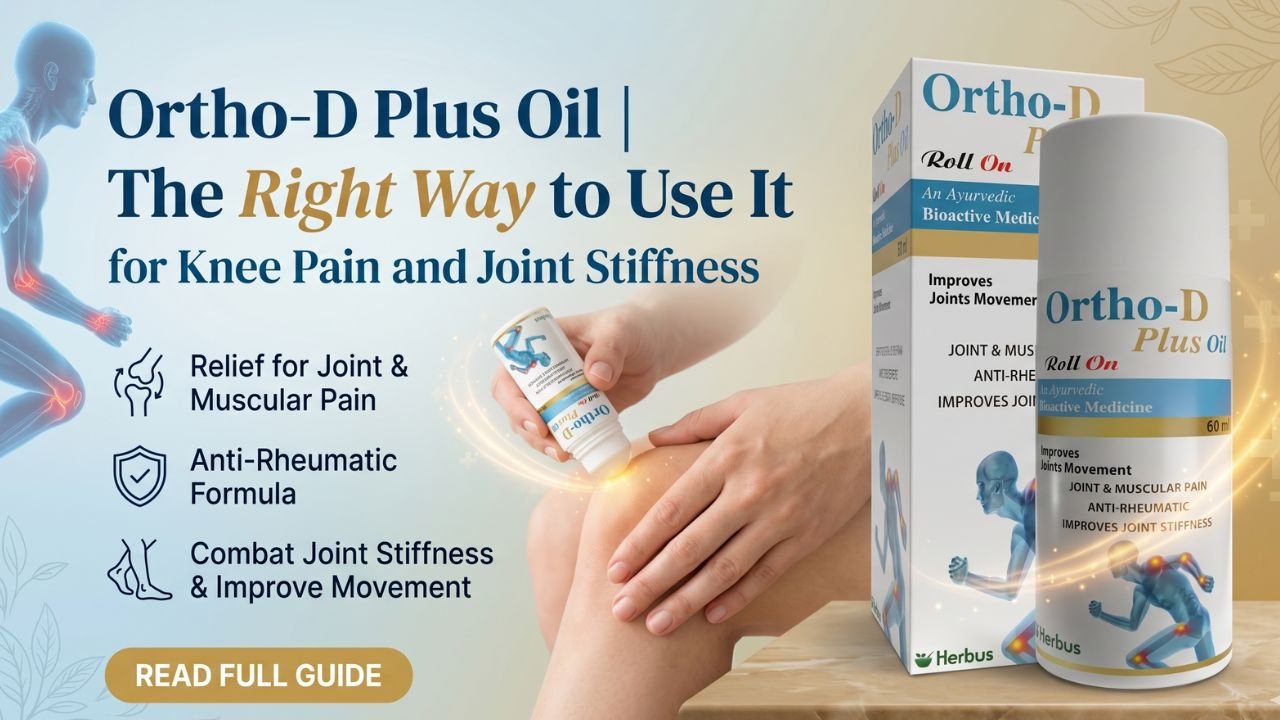
If you want to explore a topical option in a convenient format, the Ortho-D Plus Roll-On delivers the same herbal blend with precise, no-mess application directly to the joint.
The Warm Oil Protocol – Step by Step
This is the part most guides skip. In Ayurvedic practice, oil application is not a passive act.
The classical technique of Abhyanga, or therapeutic self-massage, is built on the understanding that warm oil penetrates the skin more effectively than cold oil, that slow rhythmic pressure stimulates local circulation, and that the ritual itself signals the nervous system to downregulate.
Mayo Clinic’s Dr. Jillian A. Maloney confirms the physiological logic: topical medications work best when they are concentrated at the site of pain and absorbed through the skin.
Here is the protocol that aligns with both Ayurvedic tradition and the product’s own guidance.
Step 1: Warm the oil. Place the bottle in a bowl of warm water for 3 to 5 minutes. Do not microwave it or overheat it. You want it slightly above body temperature, roughly 38 to 40 degrees Celsius.
Step 2: Measure your amount. Use 5 to 10 ml, about a palm-sized pool. This is the clinically suggested range. More oil does not create more benefit. It just slides off.
Step 3: Begin with gentle circular strokes. Start around the knee, not directly on the center of pain.
Work in slow, moderate-pressure circles, moving upward toward the thigh and downward toward the calf. This stimulates lymphatic drainage and improves local blood flow.
Step 4: Apply direct pressure to the joint. After 2 to 3 minutes of surrounding strokes, apply the oil directly over the kneecap and joint line using your thumbs in small, deliberate circles.
Step 5: Continue for 5 to 10 minutes. Consistency of pressure matters more than duration. Five focused minutes beats fifteen distracted ones.
Step 6: Rest. Do not wash it off immediately. Leave the oil on for at least 20 to 30 minutes.
In classical Janu Basti therapy (a specialized Ayurvedic treatment where a dough ring holds warm oil over the knee), the oil contact time is extended for maximum benefit. You can replicate this at home by wrapping the knee loosely in a soft cloth.
For people dealing with chronic joint issues alongside knee pain, pairing topical application with an internal support like JointFix Herbal Ortho Syrup may provide a more complete approach, working on joint health from both inside and outside.
What the Evidence Says About Ayurvedic Treatment for Knee OA
This is where honesty matters more than enthusiasm.
The NIH’s National Center for Complementary and Integrative Health states plainly that “a few studies suggest that Ayurvedic preparations may reduce pain and increase function in people with osteoarthritis, but most of these trials are small or not well-designed.” That is worth sitting with.
What we do have is encouraging. In a multicenter randomized controlled trial published in Osteoarthritis and Cartilage involving 151 patients with knee OA, the WOMAC Index improvement at 12 weeks was significantly more pronounced in the Ayurveda group (mean difference of 61.0 points) compared to the conventional care group (32.0 points).
Patients with greater baseline pain and functional limitation showed the most improvement. That is a real and meaningful signal, even if we need larger trials to confirm it fully.
The research base is growing. The real-world picture, though, requires nuance. A 2019 global burden study published in Frontiers in Medicine documented 364.58 million prevalent cases of knee OA worldwide, with 11.53 million disability-adjusted life years lost.
For many of those people, especially those with moderate-to-severe disease, topical oil is one layer of a multi-pronged strategy, not the whole answer.
Common Misconceptions That Reduce Results
“More oil means faster relief.” It does not. Excess oil simply sits on the surface and is wiped off. Absorption happens in the first thin layer. The massage technique is what drives penetration.
“It should work within a day or two.” For acute muscle soreness, you may feel relief quickly. For chronic knee OA, the literature suggests consistent use over 3 to 6 months.
Vata dosha imbalances, the Ayurvedic framework for joint dryness and degeneration, are considered slow-moving conditions that respond to steady, sustained care rather than short bursts.
“Ayurvedic means completely side-effect-free.” The NIH cautions that some Ayurvedic preparations containing metals or minerals can carry risks.
For externally applied oils like Ortho-D Plus, the risk profile is low. But do not apply it to broken skin, open wounds, or active rashes.
If you experience redness, burning beyond the expected counterirritant sensation, or allergic reaction, stop use and consult a doctor.
“This can replace treatment for inflammatory arthritis.” Rheumatoid arthritis, psoriatic arthritis, and gout are distinct from osteoarthritis and require disease-modifying medications.
As Mayo Clinic rheumatologist Dr. Shreyasee Amin explains, the body’s response to joint damage cascades through cartilage, bone, muscle, and tendons simultaneously.
A topical oil addresses symptom relief. It does not alter that underlying disease process.
For people looking to support their joints more comprehensively from within, options like Bone Grow capsules are worth exploring alongside topical care.
And if fatigue or low energy is compounding your experience of pain, Ashwagandha capsules have a growing evidence base for reducing inflammation markers and supporting overall vitality.
When to Stop and See a Doctor
Topical oil is appropriate for mild-to-moderate joint stiffness, early-stage OA, and post-exercise soreness.
You should step away from home remedies and book an appointment when the knee is visibly swollen or hot to the touch, when pain wakes you at night consistently, when you have lost significant range of motion in the joint, or when the pain followed an injury.
These are signs that something beyond surface-level inflammation may be happening.
Putting It Together
Knee pain has a way of shrinking your world, quietly. The stairs you avoid, the walks you skip, the mornings that start with a grimace instead of ease.
An Ayurvedic oil like Ortho-D Plus is not going to reverse years of joint wear.
But used correctly, with the warm oil protocol, consistent daily application, and realistic expectations backed by what the clinical evidence actually shows, it can genuinely make a difference in your daily comfort.
The Ortho-D Plus Roll-On is a practical starting point.
Pair it with movement, with warmth, and if you are dealing with broader energy or recovery challenges, consider whether internal Ayurvedic support like Shilajit Pro or a general Ayurvedic immunity and vitality tonic might complement your care.
Your knees carried you here. They deserve more than a rushed two-minute rub with cold oil.
Medical disclaimer: This article is intended for general informational and educational purposes only. It does not constitute medical advice, diagnosis, or treatment. The information provided is not a substitute for professional medical consultation, examination, or care from a qualified healthcare provider. Always consult your doctor or a licensed medical professional before starting any new treatment, supplement, or health regimen.