

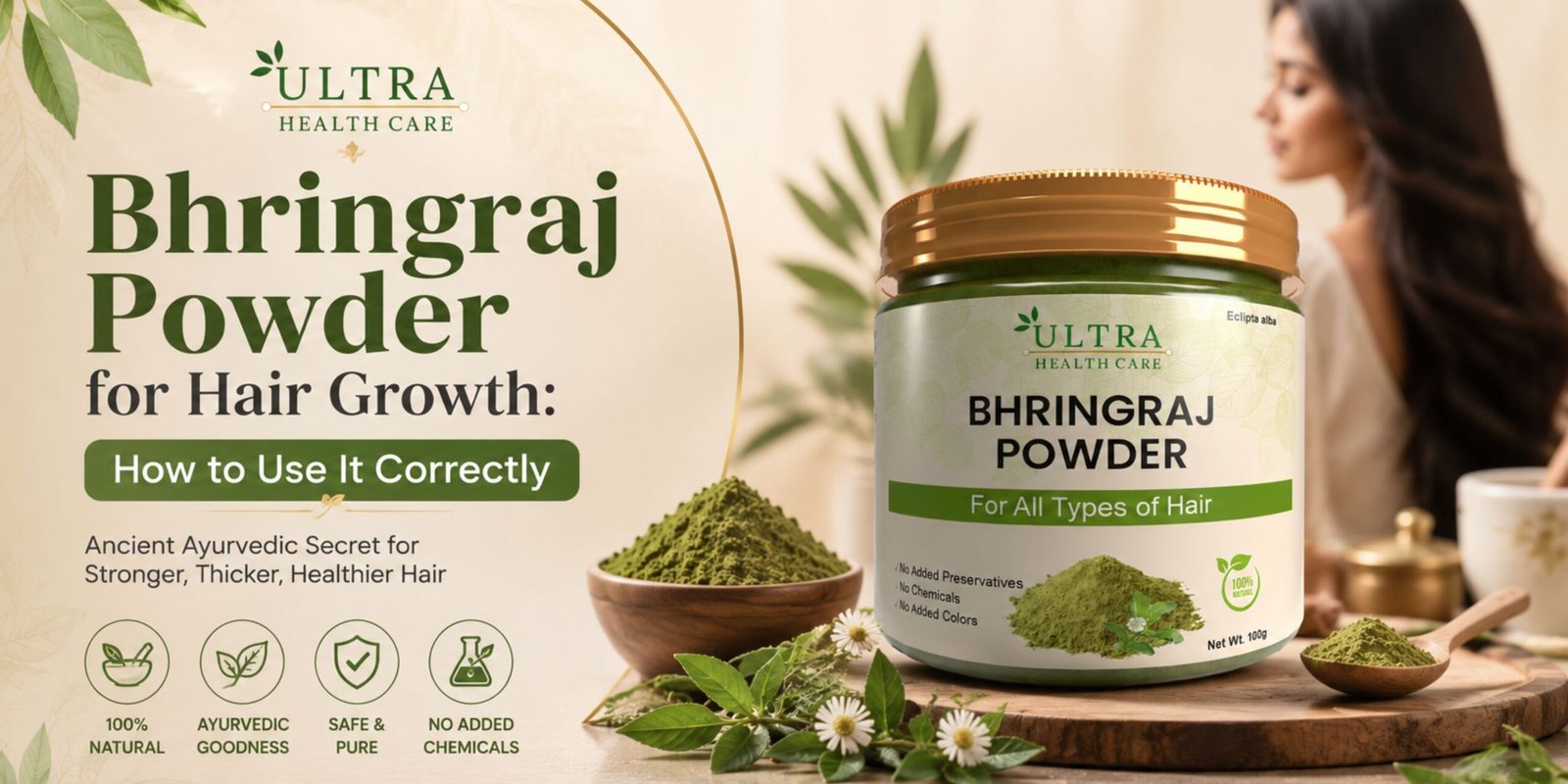
Your hair is falling more than it should. You have noticed it on the pillow, in the drain, on your comb.
You have probably googled your way through a dozen miracle cures by now and landed here, curious about this dark green powder your grandmother may have sworn by. Good. You are in the right place.
Bhringraj, known botanically as *Eclipta alba*, has been used in Ayurvedic medicine for centuries.
But here is what makes it worth your attention in 2025: the science is starting to catch up with tradition.
Not perfectly, not completely, but enough that researchers at NIH-indexed journals are taking it seriously. The question is not really whether bhringraj works.
The question is whether you are using it correctly, because most people are not.
This guide covers exactly that: the real mechanism behind the herb, how to mix it, which recipe suits your hair type, how long to wait for results, and what the clinical evidence actually says versus what influencers claim.
Key Takeaways
Bhringraj powder contains wedelolactone, a bioactive compound that research links to anagen phase stimulation and potential 5-alpha-reductase inhibition, the same enzyme pathway targeted by prescription hair loss drugs.
Results from consistent use typically appear between 8 and 12 weeks, not overnight, and the clinical trials that showed 60% improvement in hair density ran for that duration.
Powder and oil are not interchangeable. Powder delivers concentrated nutrients directly to the scalp through a mask, while oil works best for circulation-boosting massage.
Your mixing base matters: coconut oil for dry or damaged hair, yogurt for oily scalps, plain water for sensitive or chemically processed hair.
Bhringraj is a supportive therapy, not a cure for androgenic alopecia. If you are experiencing significant pattern hair loss, speak with a dermatologist before relying on any single herbal remedy.
What Bhringraj Actually Does to Your Scalp
Here is what is actually happening at the follicle level when you apply bhringraj powder.
The herb’s key bioactive compounds, including wedelolactone, ecliptine, luteolin, and several flavonoids, work through a few distinct pathways.
The most clinically interesting one involves 5-alpha-reductase inhibition, the same enzyme pathway that converts testosterone into DHT, the hormone responsible for miniaturizing hair follicles in androgenic alopecia.
A 2023 lab study published on ResearchGate found that *Eclipta alba* extract may behave similarly to finasteride in blocking this pathway, though the researchers were careful to note that the study did not examine human application directly.
Beyond DHT, bhringraj also appears to influence the hair growth cycle itself.
A 2019 study in PMC found that Eclipta prostrata promoted anagen induction and sustained the growth phase through upregulation of FGF-7 and FGF-5. In plain language: it may help your hair spend more time actively growing and less time resting and shedding.
The mice in that study showed more prominent hair growth on day 11 and day 14 than those treated with minoxidil. That is a striking finding, though animal models do not always translate to humans.
One angle almost no one talks about: bhringraj is also a well-documented hepatoprotective herb, meaning it supports liver function.
The liver processes hormones, including the androgens involved in hair loss.
A healthier liver creates what researchers describe as “a systemic milieu conducive to follicular regeneration,” which is a fancy way of saying that the whole-body effect of bhringraj may matter as much as the topical one.
For a deeper look at the full benefits of this plant, the bhringraj benefits guide on UltraHealthcare is worth your time.
Bhringraj Powder vs. Oil: They Are Not the Same Thing
This is the most common misconception. People use bhringraj powder and bhringraj oil as though they are equivalent, just different formats. They are not.
Bhringraj oil is made by infusing the herb in a carrier oil, typically sesame or coconut.
It is absorbed gradually, it feels gentle on the scalp, and it excels at improving circulation through massage. Think of it as a slow, steady nourisher.
Bhringraj powder, when mixed into a mask, delivers a concentrated dose of bioactive compounds directly to the scalp and follicle openings.
The contact is more direct. The application time is longer. The nutritional hit is different.
For practical guidance on working with bhringraj powder specifically for hair growth, there is a detailed resource that walks through the specifics.
And if you want to explore the bhringraj powder itself, quality matters more than most people realize: research published in Phytochemistry International found that wedelolactone concentrations of 0.23% to 0.41% in high-quality powder correlated dir
ectly with hair growth efficacy. When you are buying, that is the marker to look for.
How to Mix Bhringraj Powder: Recipes by Hair Type
Most guides give you one recipe and call it done. That approach ignores the reality that a mask built for dry hair will feel terrible on an oily scalp, and vice versa.
For Dry, Frizzy, or Damaged Hair
Mix 2 tablespoons of bhringraj powder with 2 tablespoons of coconut oil, warmed slightly, and 1 tablespoon of pure aloe vera gel.
The coconut oil provides deep moisture and helps the wedelolactone penetrate the shaft, while aloe vera soothes a dry, irritated scalp without adding heaviness.
Apply to the scalp and mid-lengths, leave for 30 to 45 minutes, and rinse thoroughly.
For Oily Scalps or Scalp Buildup
Swap the oil entirely. Mix 2 tablespoons of bhringraj powder with 3 tablespoons of plain yogurt and a teaspoon of lemon juice.
Yogurt’s lactic acid gently exfoliates the scalp, controls excess sebum, and lets the bhringraj compounds reach the follicle without sitting on top of a grease layer.
This is also the better choice if you have scalp inflammation or dandruff.
For Chemically Processed or Color-Treated Hair
Keep it simple. Mix bhringraj powder with plain, room-temperature water into a smooth paste, add a tablespoon of ultra multani mitti powder for gentle cleansing, and avoid acidic additions.
Chemical treatments have already shifted your scalp’s pH balance, and a neutral mask prevents further disruption.
You can also explore the premium ubtan face pack as a companion treatment for scalp-to-skin health.
The Classic Amla-Bhringraj Combination
One recipe worth its own mention: bhringraj powder combined with amla (Indian gooseberry) powder.
The amla-and-bhringraj combination is one of Ayurveda’s most time-tested pairings for scalp health, and both herbs have independent research supporting their role in the anagen phase.
Mix equal parts, combine with enough warm water to form a paste, apply for 45 minutes, and rinse. This works well for most hair types.
If you are interested in pairing bhringraj with oil-based scalp care, rosemary oil is another ingredient with a growing evidence base for follicle stimulation and makes a strong companion to any bhringraj routine.
How Often to Use It, and When to Expect Results
Let’s get the timeline right, because unrealistic expectations are the fastest way to abandon something that is actually working.
A 24-week clinical trial of standardized *Eclipta alba* extract showed roughly 62% improvement in hair shedding. Another study found 60% improvement in hair density after 8 to 12 weeks.
The landmark 2008 Springer study comparing *Eclipta alba* extracts to minoxidil in animal models found hair growth initiation time was reduced to half, but that was with consistent, repeated treatment.
The practical takeaway: do not expect results in a week.
Most people who stick with it report feeling a difference in texture and shedding by weeks four to six. Visible density changes take longer, typically the 10 to 12 week mark.
As for frequency, once or twice a week is the sweet spot. Daily application sounds more committed, but it actually works against you.
It can overload the follicles, leave residue that clogs pores, and paradoxically dry out the scalp by disrupting its natural oil balance.
What About Oral Use?
This is where topical and internal use get conflated, and the distinction matters.
Bhringraj powder can be consumed internally in small amounts, typically mixed into warm water, milk, or honey.
There is a separate clinical evidence base for oral use, including the 24-week JAIMS trial.
But the safety profile, dosing, and drug interactions for oral use are entirely different from topical application.
NCCIH guidelines specifically caution that Ayurvedic herbs can interact with medications including blood thinners, blood pressure drugs, diabetes medications, and liver-related treatments.
If you are on any of these, talk to your doctor before consuming bhringraj internally. The same applies if you are pregnant.
For those interested in internal Ayurvedic support alongside topical care, ashwagandha capsules and ashwagandha powder are well-researched options for stress-related hair loss, since elevated cortisol is one of the most underappreciated drivers of telogen effluvium.
A Note on Hair Loss Reality
Around 85% of men and 33% of women will experience hair loss at some point. That is a staggering number, and it means you are not alone in sitting here reading this, looking for something that helps.
Bhringraj is real. The research is real. But it is a supportive herb, not a pharmaceutical replacement.
The NIH’s review of Eclipta alba describes it as a promoter of anagen transition, a modulator of follicle cycling, and a plant with genuine anti-inflammatory and antioxidant activity.
What it does not do is reverse established pattern baldness at the level of finasteride or minoxidil.
It works best as part of a holistic routine: reducing scalp inflammation, supporting follicle nutrition, and giving your hair the conditions it needs to grow.
Where to Go From Here
Bhringraj powder is one of those herbs that rewards patience and consistency more than any other quality.
The research, while not perfect, points in a real direction: follicle stimulation, anagen phase support, reduced inflammation, and a possible role in DHT modulation.
That is a meaningful combination for anyone dealing with thinning hair.
Start with one mask per week. Pick the recipe that fits your hair type.
Give it twelve weeks before you decide whether it is working. And pair it with a broader approach to scalp health because no single herb does everything.
If you want to explore the full bhringraj powder option or add rosemary oil to your routine as a complement, both are worth investigating.
Your hair has been growing for your entire life. Give it the right environment, and it tends to respond.
Medical disclaimer: This article is for informational and educational purposes only. It is not intended to diagnose, treat, cure, or prevent any medical condition, including hair loss disorders. The information provided reflects published research and traditional Ayurvedic practice but should not replace professional medical advice.