

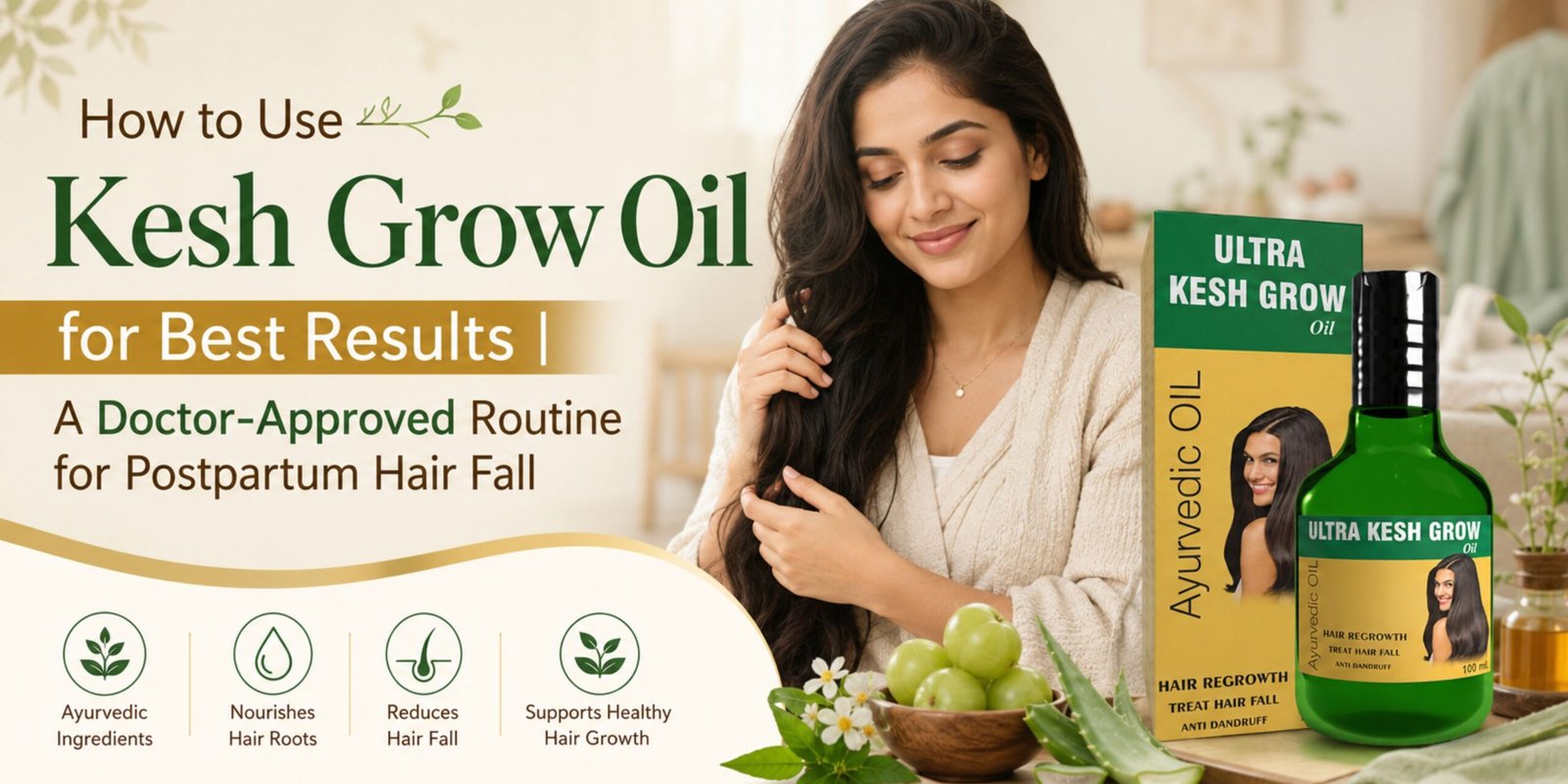
You are standing in the shower and the drain is full of hair.Again. Your baby is three months old, you are already exhausted, and now this.
You look at your hands and something in your chest tightens. *Is this normal? Is this permanent? Am I doing something wrong?*
You are not doing anything wrong. And no, this is not permanent.
But here is what nobody tells you: the oil alone is not enough. Your hair is falling because your hormones shifted, and no topical treatment can fully outwork that root cause on its own.
The good news is that Ayurveda actually figured this out centuries ago. The two-track approach, warming the scalp externally while rebalancing hormones internally, is exactly what a growing body of clinical evidence now supports.
This guide gives you the precise, week-by-week routine, the correct technique, and the internal protocol that works alongside it.
Key Takeaways
Postpartum hair loss is a hormonal event called telogen effluvium, not a sign of permanent hair loss, and it peaks around four months after delivery according to the American Academy of Dermatology.
A 2024 clinical trial published in the International Journal of Research in Dermatology found that consistent Ayurvedic hair oil use over eight weeks reduced hair fall by 63.49% and improved hair density by nearly 40%.
Correct oil application means warming the oil, sectioning the hair, massaging in small circular motions for four minutes, and leaving it on for a minimum of two hours, not slathering and forgetting.
Shatavari is not just a lactation herb. Its phytoestrogen content directly addresses the hormonal drop that triggers postpartum shedding, and it is considered safe during breastfeeding by Ayurvedic practitioners when taken at standard doses.
If hair loss continues beyond 12 months postpartum, or comes with fatigue, cold hands, or unexplained weight changes, see a dermatologist. Thyroid dysfunction can masquerade as postpartum shedding.
Why Your Hair Is Falling Out After Delivery
During pregnancy, elevated estrogen keeps your hair in the anagen (growth) phase longer than usual.
Your hair looked thick and luminous. Then you delivered, estrogen dropped sharply, and all that hair that had been holding on suddenly entered the telogen (resting and shedding) phase at once.
Dermatologists call this telogen effluvium, and it is one of the most common postpartum experiences nobody prepares you for.
According to the NIH’s StatPearls clinical reference, telogen effluvium triggered by hormonal shifts is self-limiting in most cases.
The Mayo Clinic notes that for up to five months after giving birth, women lose more hair than they grow.
Around 40 to 50% of women experience this. A 2023 survey of 900 mothers found that 81.6% had faced postpartum hair loss, yet 70.1% said they never took any action, often because they simply did not know what to do.
That is the gap this article is here to close.
The Ayurvedic view adds another layer that Western medicine is only recently catching up to.
In Ayurveda, postpartum hair loss is seen as an aggravated Vata condition. Delivery depletes Ojas (vital energy) and dries the tissues.
Bhringraj oil, sesame-based warming oils, and internal rasayanas like Shatavari are prescribed not just to feed the scalp but to restore systemic balance.
This external-plus-internal logic, it turns out, maps fairly well onto what we now know about hormonal triggers of hair shedding.
The 8-Week Kesh Grow Oil Routine
Before anything else: buy one small bowl you dedicate to oil warming, and let it become a ritual. Five minutes of warmth and intention for your scalp is not indulgent. It is functional medicine.
Step 1: Warm the Oil
Place your Ultra Kesh Grow Oil bottle in a bowl of hot water for three to five minutes.
You want it warm to the touch, not hot. Warm oil penetrates the hair follicle more effectively than cold oil and supports circulation to the scalp.
Never microwave it directly in the bottle.
Step 2: Section the Hair
Part your dry or slightly damp hair into four sections using a wide-tooth comb.
Clip three sections out of the way. Working section by section ensures the oil actually reaches your scalp rather than sitting on top of your hair shaft.
Step 3: Apply and Massage
Apply the oil directly to your scalp using your fingertips or a dropper.
Then massage in small, firm, circular motions. Not stroking. Circular.
A landmark 2016 study published in PubMed tracked nine men who did just four minutes of daily scalp massage for 24 weeks. Hair thickness increased, and the massage upregulated 2,655 genes related to the hair growth cycle, including NOGGIN and BMP4, while downregulating the hair-loss-related gene IL6.
Four minutes. That is all. Work from the crown outward, spending about 30 seconds per section before moving on.
A later MDPI Journal of Clinical Medicine study confirmed this further: 68.9% of 327 respondents who practiced regular scalp massage reported hair loss stabilization or regrowth. The mechanism is real.
Step 4: Dwell Time
Leave the oil on for a minimum of two hours. Overnight is ideal, two to three times per week.
Do not oil daily. Over-oiling with heavy products can clog follicles and cause mechanical breakage when you comb out.
Consistent, correct application wins over frequent careless application every time.
Step 5: Wash Out Properly
Use a gentle, sulfate-free shampoo as Johns Hopkins Medicine recommends for postpartum hair care.
Apply shampoo to dry oiled hair first, work it in, then add water.
This method emulsifies the oil without stripping your scalp. Rinse, repeat if needed, and condition mid-lengths to ends only.
The 8-Week Progression
Weeks 1 and 2: oil two times per week, four-minute massage each session. Focus on getting the technique right, not the quantity.
Weeks 3 and 4: increase to three times per week. You may notice increased shedding briefly. This is normal; it means old telogen hairs are exiting to make room for new anagen growth.
Weeks 5 through 8: maintain three times per week. Look for baby hairs along your hairline by week six.
These are your anagen phase hairs returning. The 2024 IJRD clinical trial using an Ayurvedic hair oil protocol showed hair growth rate improved by 79.92% over eight weeks, with no adverse effects reported.
The Internal Protocol: Where Shatavari Comes In
Most postpartum hair guides stop at the oil. That is the single biggest gap.
You can massage your scalp every night, and if your estrogen is still in free fall, you are working against the tide.
Organic Shatavari powder has been used in Ayurvedic postpartum care (Sutika Paricharya) for centuries.
Its phytoestrogenic compounds help moderate the hormonal swing that triggers telogen effluvium after delivery.
Modern research backs this up: Shatavari’s antioxidant properties and hormone-modulating effects address not just lactation, as it is commonly reduced to in popular culture, but also postpartum hair loss, mood fluctuations, and fatigue.
A 2021 systematic review noted its adaptogenic qualities in female hormonal health.
For breastfeeding mothers, standard Shatavari doses (around 500 mg to 1 gram of powder daily, mixed into warm milk or water) are generally considered safe.
That said, speak to your OB-GYN or Ayurvedic physician before adding any herb to a postpartum or breastfeeding routine. This is not a place to self-prescribe aggressively.
Alongside Shatavari, Ashwagandha capsules are another option some postpartum care protocols include for their cortisol-regulating effects.
High cortisol is itself a hair-loss trigger, and new mothers carry more cortisol than almost any demographic.
For a deeper look at how Ashwagandha supports hormonal balance, this related guide on Ashwagandha for hormonal health covers the evidence well.
The Supporting Ingredients That Make Kesh Grow Oil Work
Understanding what is in your oil helps you trust the process. The key Ayurvedic actives in a well-formulated Kesh Grow oil typically include:
Bhringraj (Eclipta prostrata): Called the “king of herbs for hair” in Ayurvedic texts.
A standardized Amla extract study published in PMC found significant improvement in hair growth rate, density, and terminal hair density over 90 days.
Bhringraj shares similar follicle-stimulating mechanisms. For a full breakdown of how it works, read this guide on Bhringraj benefits for hair, and for practical use, this Bhringraj powder for hair growth guide is worth bookmarking.
You can also find quality Bhringraj powder to use as a complementary hair mask.
Amla (Indian Gooseberry): A randomized controlled trial in the Journal of Ethnopharmacology showed Amla syrup significantly increased the ratio of anagen-to-telogen phase hairs in women with hair loss, with high physician and patient satisfaction versus placebo.
Amla in your oil is doing real work, not just adding a nice color.
Rosemary: Growing clinical support positions rosemary as a scalp circulation booster comparable to minoxidil in some studies.
The Ultra Rosemary Oil is worth considering as a complement to your Kesh Grow routine, especially on non-oil days as a lightweight treatment.
For days when you want something soothing between oil sessions, applying a thin layer of pure aloe vera gel to the scalp can reduce inflammation and create a calm environment for hair follicles to recover.
Dosha-Based Oil Personalization (What Most Guides Skip)
Ayurveda does not give everyone the same prescription, and that logic applies here. If you run warm, get scalp inflammation easily, or your hair loss comes with a slightly itchy or red scalp, you are likely experiencing Pitta-aggravated hair fall.
You do better with a cooling, coconut-based formulation. If your scalp is dry, your hair texture has turned coarse since delivery, and you feel cold and anxious, that is Vata dominance.
A sesame or almond oil base is more appropriate, exactly the kind of warming base used in traditional Neelibhringadi Taila.
Knowing your primary dosha is not mysticism. It is personalization, and it matters for which formulation of Kesh Grow oil you choose and how frequently you apply heat during your scalp massage sessions.
When to See a Doctor
Dr. Jessica Shepherd, board-certified OB-GYN, has said plainly: “Many doctors shrug off female hair loss in general and don’t understand the emotional connection between a woman’s hair and her well-being.” You deserve to be taken seriously. Push for answers if you need them.
See a dermatologist if:
Your hair loss continues beyond 12 months postpartum without signs of slowing. Most women see normal fullness return by their baby’s first birthday, per the AAD. If yours has not, something else may be going on.
You have fatigue that feels bone-deep, unexplained weight gain or loss, cold hands and feet, or brain fog alongside the hair loss. These are thyroid red flags. Postpartum thyroiditis affects roughly 5 to 10% of women and can look exactly like standard postpartum shedding.
Your hair is falling out in patches rather than diffusely. That is a different condition entirely.
A 2023 study in the International Journal of Women’s Dermatology found that duration of breastfeeding was an independent predictor of postpartum hair loss, with women who breastfed for six to twelve months showing an adjusted odds ratio of 5.96 for hair loss. Breastfeeding is beautiful and worth it.
It also means your hair recovery timeline may extend a bit longer, and that is something your doctor should factor into any assessment.
Putting It Together
Here is the actual takeaway, said plainly: your hair fell because of hormones, not neglect.
No amount of guilt or extra oiling will fix a hormonal event faster than your body is ready.
What you can do is give your scalp the circulation, nourishment, and follicle stimulation it needs through a correct oil routine, while supporting your body’s internal hormonal recovery through Shatavari and good nutrition. That is the two-track approach.
External and internal, working in parallel.
You do not need twenty products. You need the right two or three, used correctly, for long enough to let your biology catch up.
Start tonight. Warm the oil. Section your hair. Four minutes of circular massage. That is enough for day one. The rest follows from there.
Medical disclaimer: This article is intended for general informational and educational purposes only. It does not constitute medical advice and should not be used as a substitute for professional medical consultation, diagnosis, or treatment. The information provided about Ayurvedic herbs, including Shatavari and Ashwagandha, reflects traditional use and available research but has not been evaluated by the Food and Drug Administration or equivalent regulatory bodies. Always consult a qualified healthcare provider, OB-GYN, dermatologist, or certified Ayurvedic practitioner before beginning any new herbal supplement regimen, especially during the postpartum period or while breastfeeding.