

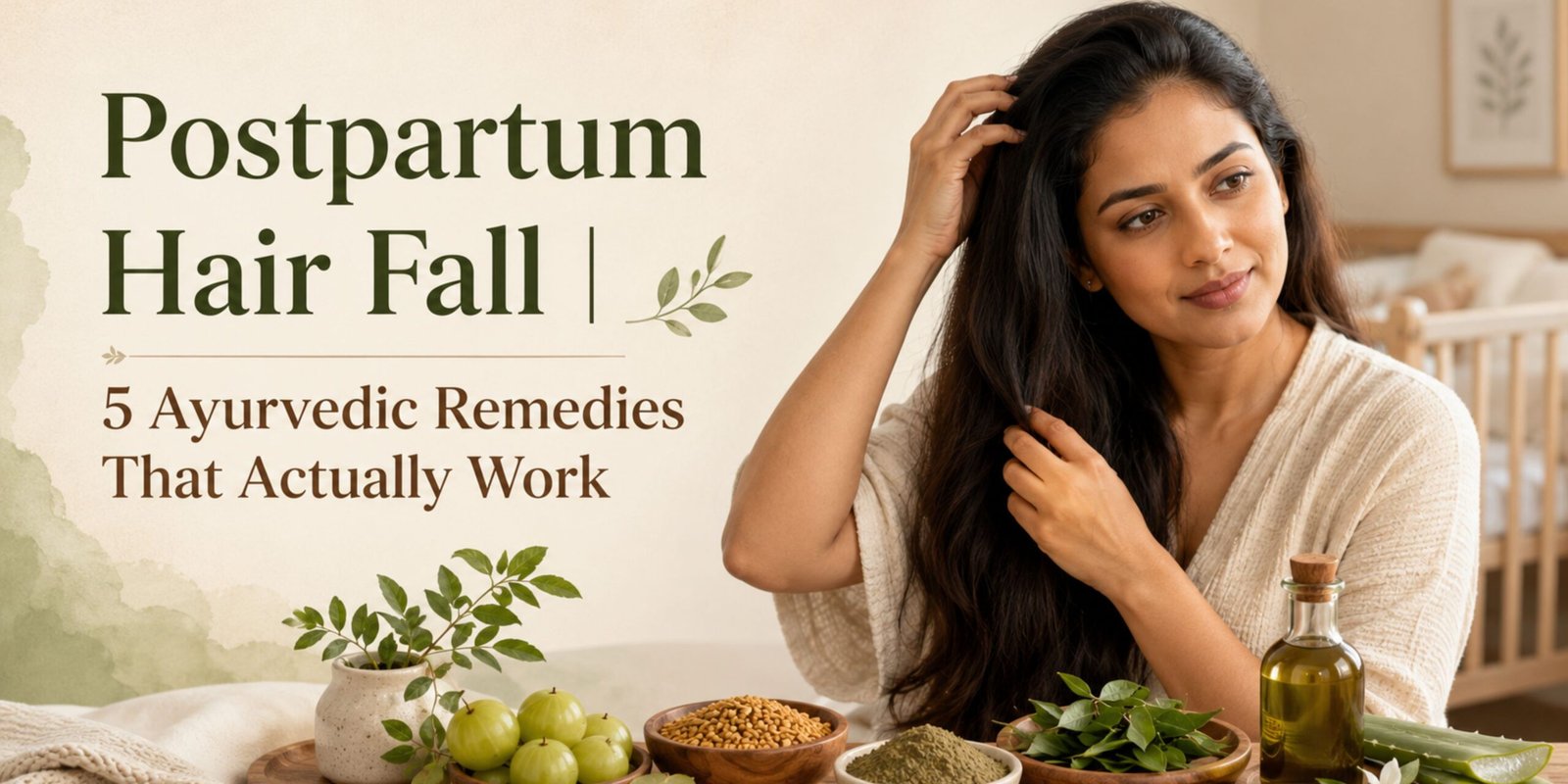
You are standing in the shower, and the drain is clogged again. With your hair. You pull out a clump the size of a small bird’s nest and feel something cold move through your chest.
Is this normal? Is it going to stop? Did I somehow break my body making this baby?
You did not break anything. What is happening to you has a name, a timeline, and this is the part most articles skip a set of genuinely effective remedies rooted in centuries of Ayurvedic practice and now increasingly backed by modern clinical research.
A 2023 study published in the International Journal of Women’s Dermatology followed 331 postpartum breastfeeding women and found that 91.8% experienced hair loss.
The average onset was 2.9 months after delivery, peak shedding at 5.1 months, and natural cessation at around 8.1 months.
So if you are four months postpartum and watching your hair come out in handfuls, you are not alone. You are, statistically, almost everyone.
What follows is not a generic list of “eat more protein and apply coconut oil.”
This is the real picture the physiology, the Ayurvedic science, and five remedies with enough clinical weight behind them to actually matter.
Key Takeaways
Postpartum hair fall is a temporary hormonal reset called telogen effluvium, affecting nearly 9 in 10 breastfeeding women, and most women recover fully within a year.
The root cause is the sudden post-delivery drop in estrogen, which pushes hair follicles from the growth phase into the resting and shedding phase simultaneously.
Shatavari, Bhringraj, Amla, Ashwagandha, and Aloe Vera are the five Ayurvedic remedies with the strongest combination of traditional use and emerging clinical evidence.
Indian women face a compounding risk: India carries the world’s highest rates of iron deficiency anemia, and low ferritin (below 40 ng/mL) drives hair loss even when your blood count looks normal.
If hair shedding is still heavy after six months, or comes with fatigue, feeling cold, and dry skin, get your thyroid and ferritin checked before assuming Ayurveda or more oil is the answer.
What Is Actually Happening Inside Your Scalp
During pregnancy, surging estrogen keeps your hair locked in the anagen (growth) phase.
Normally, up to 100 hairs shed daily from a scalp of 80,000 to 120,000 hairs. During pregnancy, that shedding slows dramatically.
The hair that should have fallen out over nine months stays. Then the baby arrives, estrogen collapses, and all of it falls at once.
This is telogen effluvium, defined by NIH as “the excessive shedding of resting or telogen hair after metabolic stress, hormonal changes, or medication.”
It is not hair loss in the clinical sense. It is delayed shedding, catching up all at once.
Ayurveda understood this pattern long before the term telogen effluvium existed. Postpartum is classified as a deeply Vata-dominant phase, cold, dry, depleted, and erratic.
Vata governs movement and circulation. When it is aggravated, as it invariably is after labor and delivery, nourishment to the asthi dhatu (bone and structural tissue) and by extension the hair roots is compromised.
The Ayurvedic solution is not to fight the shedding directly. It is to rebuild the ground the hair grows from.
The Ferritin Problem Nobody Talks About
Before we get to the remedies, there is a critical conversation happening in dermatology clinics that rarely reaches new mothers: your regular blood test may show normal hemoglobin while your ferritin is quietly tanking your hair.
Ferritin levels below 40 ng/mL are associated with hair loss even when anemia is not present.
Standard postpartum blood panels often check hemoglobin, not ferritin. This distinction matters enormously in India, where approximately 53% of non-pregnant Indian women of reproductive age already have iron deficiency anemia before they deliver.
If you are breastfeeding and postpartum and Indian, ask your doctor specifically for a serum ferritin test.
This one number can change everything about your treatment plan.
Similarly, postpartum thyroid dysfunction affects 5 to 10% of women in the year following childbirth.
Thyroid-related hair fall looks identical to telogen effluvium but does not respond to Ayurvedic herbs.
The warning signs — intense fatigue, constipation, feeling cold even in warm rooms, heavy periods, are easy to dismiss as new-mom exhaustion. Do not dismiss them.
5 Ayurvedic Remedies for Postpartum Hair Fall
1. Shatavari: The Hormonal Anchor
Shatavari (Asparagus racemosus) is perhaps the single most important Ayurvedic herb for the postpartum period.
It is a Rasayana, a rejuvenating herb specifically indicated for women’s hormonal health.
Traditionally used to support lactation and rebuild ojas (vital energy) after delivery, it has now earned clinical attention as well.
A 2025 randomized, double-blind, placebo-controlled trial of 120 postpartum women found that Shatavari root extract (300 mg) significantly improved breast milk production, hormonal balance, and maternal satisfaction, with no adverse effects reported.
For postpartum hair loss, the connection is indirect but real: by stabilizing the hormonal environment, Shatavari slows the sharp estrogen crash that triggers mass shedding.
Dr. Ayush Varma, MD (Ayurvedic Medicine, AIIMS 2008), recommends starting with Shatavari granules mixed in warm milk daily, used consistently for at least 8 to 12 weeks.
Breastfeeding safety note: Shatavari is considered safe for nursing mothers in traditional Ayurvedic practice and in the 2025 RCT, but please consult your vaidya or gynecologist before starting any supplement while breastfeeding.
For a practical daily option, explore this organic shatavari powder as a starting point for your routine.
2. Bhringraj: The King of Hair Herbs
Bhringraj (Eclipta alba) is called Keshraj in Sanskrit, the king of hair. It has been used in Ayurvedic hair formulations for over two thousand years, and modern lab research is beginning to explain why.
A 2023 study published in ResearchGate found that Bhringraj extract may function similarly to 5-alpha-reductase inhibitors, the same class of drugs used in pattern baldness treatment.
This suggests a DHT-blocking mechanism that could be particularly useful in postpartum women experiencing hormone-driven shedding.
Applied topically as an oil, Bhringraj works by improving scalp circulation, reducing inflammation around the hair follicle, and nourishing the root directly.
Applied internally as a powder, it supports liver function, which plays a role in estrogen metabolism.
You can read more about its full therapeutic profile in this guide to bhringraj benefits and in this detailed look at bhringraj powder for hair growth.
For adding it to your routine, bhringraj powder can be mixed with warm water or coconut oil for a weekly scalp mask.
Apply, leave for 30 to 45 minutes, and wash with a gentle herbal shampoo.
3. Amla: The Vitamin C Multiplier
Amla (Indian Gooseberry) deserves its own section because of something specific to the Indian postpartum context.
Micronutrient research published in PMC (NIH) confirms that deficiencies in vitamins and minerals are modifiable risk factors in hair loss.
Amla is one of the richest natural sources of Vitamin C on earth, and Vitamin C is the nutrient that converts dietary iron into a form the body can actually absorb.
Given that over half of Indian women of reproductive age have iron deficiency before delivery, adding Amla to the postpartum diet is not a wellness trend.
It is a targeted nutritional intervention. It also contains tannins and gallic acid that protect the scalp from oxidative stress, which spikes postpartum.
You can consume Amla as a fresh fruit, a churna (powder) in warm water, or in combination hair formulations.
4. Ashwagandha: The Stress Circuit Breaker
This one often surprises people. Ashwagandha is not traditionally thought of as a hair herb.
But consider this: a 2023 analysis reported by News-Medical.net found that postpartum anxiety was independently associated with a 4.6-fold increase in postpartum hair loss.
Cortisol, the stress hormone, directly disrupts the hair growth cycle.
Ashwagandha is one of the most well-studied adaptogens in clinical literature, shown repeatedly to reduce cortisol and support resilience to chronic stress.
As an ashwagandha capsule taken consistently, it addresses postpartum hair loss from the stress pathway rather than the hormonal one.
The two pathways are different. Many women need both addressed.
Breastfeeding note: Ashwagandha use while nursing is an area where Ayurvedic and allopathic guidance diverges. Consult your doctor before use.
5. Aloe Vera and Rosemary: The Scalp Environment Reset
The fifth remedy is less about a single herb and more about the scalp environment.
Ayurveda has always emphasized that the soil matters as much as the seed.
A scalp clogged with excess sebum, inflammation, or weak circulation cannot support healthy regrowth, no matter what you take orally.
Pure aloe vera gel applied directly to the scalp reduces inflammation, balances pH, and creates a clean environment for emerging hair.
Rosemary has attracted significant clinical interest recently, with studies suggesting it improves scalp circulation comparably to minoxidil in some cases.
Explore how rosemary oil improves hair growth and strengthens hair as a topical weekly treatment.
A comprehensive hair growth oil that combines traditional scalp-nourishing herbs is this ultra kesh grow oil, formulated for exactly the kind of postpartum depletion Ayurveda calls Vata-vitiated hair loss.
When to Stop Waiting and See a Doctor
The American Academy of Dermatology recommends seeing a dermatologist if your hair has not regained its normal fullness by your baby’s first birthday.
Johns Hopkins Medicine echoes this, noting that hair typically returns to its normal growth cycle within 6 to 12 months. If yours has not, something else is driving the loss.
Stop experimenting with home remedies and get blood work done if you notice hair fall heavier than expected past six months, combined with exhaustion that sleep does not fix, cold intolerance, dry skin, constipation, or mood changes far beyond typical new-mom fatigue.
Thyroid dysfunction and persistent ferritin deficiency do not respond to herbs alone.
A Word Before You Go
Postpartum hair fall is not your body failing you. It is your body completing a massive hormonal transition, and your hair is telling you the story of that transition.
As Mayo Clinic explains, the shedding stops on its own as hormones restabilize.
What Ayurveda offers here is not magic. It is a systematic approach to rebuilding the depleted postpartum body from the inside out, with herbs that have been used for exactly this purpose for centuries, and some of which are now earning controlled trial evidence.
Start with one or two remedies consistently rather than ten remedies chaotically. Give them 8 to 12 weeks. Watch your ferritin.
Support your stress load. And if something feels off beyond typical exhaustion, get the thyroid checked.
Your hair will come back. It almost always does.